
Are you traveling to Tbilisi, Georgia, and looking for things to do? Look no further! I’ve got 30 great landmarks, museums, and activities you can do in Tbilisi, whether you’re in town for a weekend or a full week!
This page contains affiliate links. If you buy through these links, I may receive a small commission, at no additional cost to you. I only recommend products or services I have tried and/or find useful and reliable.
- Tbilisi Travel Tips
- Free Things to Do in Tbilisi
- 1. Get lost in Old Town Tbilisi
- 2. Climb the Betlemi Street Stairs to Mother of Georgia
- 3. Explore the charming Abanotubani neighborhood
- 4. Witness the puppet show at The Clock Tower
- 5. Cross the river on the Bridge of Peace
- 6. Visit the Zion Cathedral of the Dormition of Tbilisi
- 7. Check out the chaotic Dezerter Bazaar
- 8. Wonder at the imposing Chronicle of Georgia
- 9. Visit the Holy Trinity Cathedral of Tbilisi
- 10. Browse for hidden gems at the Dry Bridge Market
- 11. Check out the Metekhi Church of the Nativity of the Mother of God
- 12. Enjoy sweeping city views from the Tabor Monastery of the Transfiguration
- 13. Wander around Mtatsminda Park and enjoy the views
- 14. Check out beautiful street art
- 15. Stroll down the polished Rustaveli Avenue
- 16. Enjoy the view from the lovely Queen Darejan’s Palace
- 17. Join a free walking tour
- Paid Attractions and Activities in Tbilisi
- 18. Ride the cable cars
- 19. Indulge in Georgian food
- 20. Visit the newly restored Silk Museum
- 21. Go for a walk in the National Botanical Garden
- 22. Check out contemporary art at MoMA Tbilisi
- 23. Learn about local history at the Georgian National Museum
- 24. Experience a sulfur bath
- 25. Sample Georgian wines
- 26. Have dinner and drinks at Fabrika
- 27. Attend a show at Tbilisi Opera and Ballet Theatre
- 28. Admire beautiful artworks at the Georgian Museum of Fine Arts
- 29. Join a cooking class
- 30. Sample Georgian tea at Bitadze Tea Museum
- Getting to and Staying in Tbilisi
I spent almost three weeks in Georgia in October 2024, including one week in Tbilisi, and I feel like I barely scratched the surface when exploring the capital city. Tbilisi is a big city with lots of things to do, so you can’t expect to see it all on a weekend trip. Add to that all the amazing day trips to the surrounding areas, and you need at least five days. But if a short trip is all you can manage, that’s okay.
Spending one week in Tbilisi while working and trying to fit in as much exploring as possible means I’ve managed to get to know the city a fair bit, yet I still feel the need to go back and fill some gaps. I think I did a good job on touching on the highlights and exploring a few lesser-known spots, so I want to share them all with you.
This Tbilisi travel guide contains all the things I did in the city, plus a few that were on my list and for one reason or another I didn’t get to do. Because, of course, that one museum you were saving for last is closed on your last day in the city. But that means I’ll have to go back, and I’m not too mad about that.
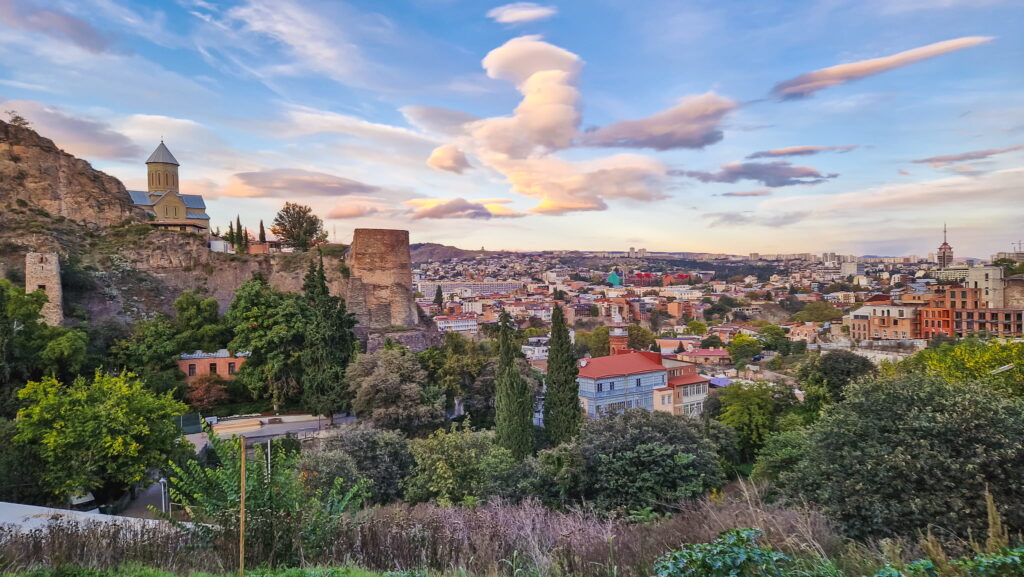
I loved all of Georgia. It had been on my bucket list for quite some time, and spending almost three weeks there made me fall in love. If you’re planning a trip and want to go beyond Tbilisi, I have a few other articles you can check out:
Tbilisi Travel Tips
Before diving into the things to do in Tbilisi, I want to cover a few useful travel tips for the capital as well as the rest of Georgia.
Safety: Tbilisi is among Europe’s safest capital cities. Yes, petty theft can happen, so watch out for your belongings in crowded areas. But overall, I found Tbilisi very safe, even walking around by myself in the evening.
Money: The Georgian currency is the lari (GEL). One lari equals roughly € 0.31 or US$0.37. For convenience, I always think 1€ = 3 lari. It’s not precise, but it’s easy to convert while I’m out buying stuff. Also, while many places accept card payment, you should absolutely withdraw cash for public transportation and even some small shops.
Transportation: In Tbilisi, you can get around by metro or bus. You can buy a rechargeable MetroMoney Card, where you can add balance and pay for each trip (1 lari for bus and metro rides), or a Travel Card for daily, weekly, or monthly passes. You can also pay by card on buses or the metro, but each ride is 1.5 lari instead of 1. Find all the fares on the Tbilisi transport website.
Language: Georgian is the official language, and the alphabet is completely different from that of any other language. However, most people speak some level of English in Tbilisi. Still, I think it’s worth learning a few basic words, like Gamarjoba (hello) and Madloba (thank you).
SIM cards: You can either purchase a SIM card when you arrive in Georgia (Magti is the most popular provider) or get an eSIM. I opted for the latter, using Airalo, and it worked great for the nearly three weeks I spent in Georgia. Also, there is a free, public Wi-Fi available in some areas of the city called “Tbilisi Loves You”.
Travel insurance: As for every international trip, make sure you have travel insurance. I recommend SafetyWing, which works in 185 countries and is great for both short trips and long-term travel to multiple destinations. The policy extends automatically every month, so you don’t end up without coverage. You can sign up here or read my detailed article about SafetyWing if you need more info.
Apps: I recommend having Google Maps for navigation, Xe Currency Exchange, Bolt for ridesharing (also Yandex Taxi, but I prefer Bolt), Airalo or Saily for eSIM, and Google Translate.
A note about taxis: always use an app, it’s easier and safer to avoid scams! While I never tried to take a taxi in Georgia, I’ve heard that many don’t have meters, so you need to agree on the price in advance. That can be tricky when you don’t speak the language.

Best season to visit Tbilisi
I traveled to Georgia in October, and it was great. I don’t have personal experience with other seasons, but early fall is a top choice for fewer crowds and overall good weather. It did get a bit colder towards the end of the month, but it was still nice and sunny most of the time.
However, Tbilisi looks like a great city to visit year-round. It can get very hot in the summer and quite cold in the winter, but I bet the festive atmosphere will make it a cozy destination. Spring should be a great season to visit, too, much like fall. Maybe opt for later spring to avoid the rainy season.

Free Things to Do in Tbilisi
I thought I’d separate the top things to do in Georgia’s capital city between free and paid, this way you can easily browse between the two categories, especially if you’re on a budget. Tbilisi is quite inexpensive, so even the paid activity will hardly break the bank. But I find it useful to make this distinction. So, let’s begin with the free things to do in Tbilisi.
1. Get lost in Old Town Tbilisi
Let’s start with the basics. The best way to enjoy Tbilisi is to meander around its various neighborhoods and allow yourself to get lost. Old Tbilisi is a vast area comprising several neighborhoods, but to make exploring easier, I’ll refer to the area west of the Kura River, between Narikala Hill, Liberty Square, and Baratshvili Bridge.
This area features narrow cobbled streets, historical buildings, churches, and lovely squares. I could dedicate an entire article to this area, but to keep this short, I’ll just mention the places you absolutely must see and let you discover the rest.
I have dedicated sections to some landmarks in this area, but you must absolutely check out Gudiashvili Square, the lively Jan Shardeni Street with its cafés and bars, the streets around the Ateshgah Zoroastrian Temple, and the statue of Tamada, the Georgian toastmaster.

2. Climb the Betlemi Street Stairs to Mother of Georgia
If you don’t want to pay for the cable car (which I’ll mention in the paid activities), you can easily hike up to the most iconic sight in Tbilisi: Mother of Georgia, aka Kartlis Deda. The towering statue looks over Tbilisi from a vantage point at the top of Sololaki Hill.
Update about Narikala Fortress: When I visited in late 2024, the fortress was closed for renovation, and it still shows as closed on Google Maps. According to some news, reopening is expected in the fall of 2025, but I couldn’t find more accurate information.
Even if the fortress is still closed, it’s worth going up the hill to enjoy amazing views of Tbilisi from above and check out Mother of Georgia up close. If you look at the statue, you’ll notice the woman holds a bowl of wine in her left hand and a sword in her right. The wine is to welcome those who come to Georgia as friends, while the sword is to slay those who come as enemies. The statue was erected in 1958 to celebrate the city’s 1500th anniversary.

3. Explore the charming Abanotubani neighborhood
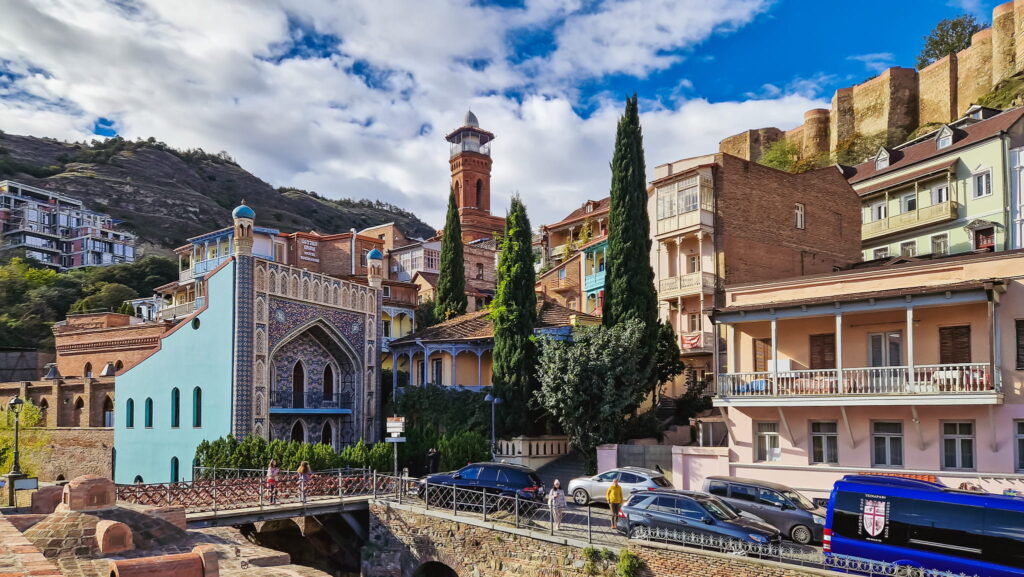
Abanotubani was probably my favorite neighborhood in Tbilisi. A part of Tbilisi Old Town, Abanotubani takes its name from the sulfur baths discovered in the area centuries ago. Abanotubani literally translates to “bath district” (abano=bath and ubani=district).
You should head to Abanotubani for the unmissable sulfur bath experience, which I will discuss in more detail in the paid activities section. But even simply wandering around the area is amazing. Be sure to cross the Bridge of Love and admire the beautiful Chreli Abano.
Walk up the hills and explore the neighborhood’s charming streets to discover little viewpoints offering stunning views of the layered old town, with its colorful houses seemingly stacked one on top of the other.
4. Witness the puppet show at The Clock Tower
The Clock Tower in Tbilisi must be the quirkiest clock tower I’ve ever seen. This incredible structure was entirely built by Rezo Gabriadze, a Georgian playwright, film director, and sculptor. And despite the looks, it was only completed in 2010, after a four-year construction period.
Get closer to the clock tower to admire all the small, quirky details, like the decorated tiles, the tiniest clock in the world, and the plaque with the weight of the world. Fun fact, under the weight of the world, there’s another plaque with a Georgian phrase that says, “If you want to know the weight of the world before you were born, you have to jump.”
Every day at noon and 7 pm, you can witness a little puppet show. First, an angel comes out on the little balcony at the top and rings the bell; then, a screen opens below and shows the “Circle of Life,” with puppets representing the various stages of life, from birth to death. Funnily enough, in one week in Tbilisi, I never managed to be around here at noon or 7 pm.


5. Cross the river on the Bridge of Peace
There are many bridges crossing the Kura River in Tbilisi. This glass pedestrian bridge is a new addition to Tbilisi’s bridge landscape, inaugurated in 2010. Many locals criticized the modern structure for being an unnecessary, flashy addition that had no practical purpose.
The futuristic bridge, though supposed to resemble a marine animal, was nicknamed “Always Ultra” by locals, as it’s said to resemble a maxi pad (Always is a menstrual hygiene products brand).
I personally like how this futuristic-looking bridge contrasts with the surrounding Old Town. On a sunny day with blue skies, the bridge offers wonderful views of Tbilisi and its beautiful old town buildings. But the bridge is also lovely at night, when thousands of LEDs illuminate it in various colors and patterns.

6. Visit the Zion Cathedral of the Dormition of Tbilisi
Standing in the heart of Old Town Tbilisi, the Cathedral of the Dormition, also known as Sioni Cathedral, dates back to the 6th century, but it was rebuilt multiple times throughout the centuries after being destroyed by invaders.
The cathedral interior still bears the signs of the centuries, and you see how the church has changed during the various renovation phases. You can especially note the distinct differences between the more recent Russian frescoes and the medieval Georgian ones. The exterior, on the other hand, remains in typical medieval Georgian style.
Being centrally located, it’s easy to just stop by on your tour of the old town. One thing to remember is to dress modestly. This means shoulders and knees should be covered, and women must cover their heads. I always carried a scarf in my backpack in Georgia for this very purpose.

7. Check out the chaotic Dezerter Bazaar
Nothing will make you experience Georgian culture in a more authentic way than visiting the local markets. Dezerter Bazaar is not one of those curated fresh food markets you’ll see around Western Europe. No, this place is chaotic, loud, vibrant, and filled with local charm.
The market was established as a marketplace for deserting soldiers to sell gear, hence the name Dezerter Bazaar. It then grew to become the largest market in Tbilisi, selling everything from fresh veggies, fruits, and spices to clothes and household items.
Whether you want to buy local products to bring home, grab some churchkhela as a snack while exploring, or immerse yourself in the scents, sounds, and colors of the vibrant market, you must make the trip to Dezerter Bazaar.

Note: Churchkhela, also known as Georgian Snickers, is the most traditional snack in Georgia. To be honest, I would think of anything but Snickers when eating it, but it’s a really nice snack, made with nuts dipped in thickened grape juice and hung to dry in the sun. You’ll find them in any market in Georgia in different colors and flavors.
8. Wonder at the imposing Chronicle of Georgia
I expected this monument to be impressive, but I was not prepared for feeling so small. This place is incredible, the decorated towering pillars reaching up so high you’ll have to crane your neck to admire them.
The monument, inaugurated in 1985, was created by Georgian sculptor Zurab Tsereteli. It consists of 16 bronze pillars decorated with biblical and historical scenes narrating the life of Christ and stories of kings and queens.
The monument is often called “Georgia’s Stonehenge,” but, having visited the namesake, I can tell without a doubt this one is cooler. While it may not be an ancient landmark, the simple fact of being able to walk among the columns makes it so much more impressive. Not to mention, there are barely any people around.
The Chronicle of Georgia is a bit out of town, so while there’s no access fee, you must pay for either public transportation or Bolt/taxi to get there. I visited with a friend I met in Tbilisi, and we took the metro to Guramishvili, then a Bolt to get there. On the way back, we took a bus and the metro to the center.

9. Visit the Holy Trinity Cathedral of Tbilisi
Towering over the city from a hilltop in the Avlabari neighborhood, the Holy Trinity Cathedral of Tbilisi is a recent construction, completed in 2004. It is among the largest Orthodox cathedrals in the world.
The cathedral is beautiful by day, but possibly even more impressive by night, when it’s lit up and stands out, visible from nearly anywhere in Tbilisi Old Town. I visited in the late afternoon, so by the time I left, the night had fallen, and I could see the illuminated façade as I descended back into town.
You can access the cathedral for free at any time during opening hours. As for any other orthodox church, you must remember to cover your shoulders, knees, and head for women.

10. Browse for hidden gems at the Dry Bridge Market
This one is only free if you can resist buying anything, and that can be a challenge. If you like flea markets, then this must absolutely be on your list of things to do in Tbilisi, even if it’s just for walking around.
You can find lots of quirky items at the Dry Bridge Market, from Soviet-era memorabilia to antiques and handmade arts and crafts. You can check out beautiful handmade carpets, ceramics, old postcards, and random objects. It’s a real treasure trove for vintage items enthusiasts.
The market is open daily all year round, but most vendors come on weekends. Since it’s all outdoors, there will be fewer vendors when the weather is bad, particularly if it rains or snows. The market is also closed on major holidays.

11. Check out the Metekhi Church of the Nativity of the Mother of God
You’ll undoubtedly notice this church when strolling along the Kura River in Old Town Tbilisi. The construction sits perched on a rocky hill on the riverside, with an equestrian statue standing tall nearby. The statue represents King Vakhtang Gorgasali, the city’s legendary founder.
The 13th-century Georgian-style church itself is beautiful, and you should absolutely check out the interior, especially since it doesn’t cost anything. But I loved the views of Tbilisi Old Town from up there.
Once you cross Metekhi Bridge, it’s an easy climb up to the church, which features a wide square to admire the view of the Kura River just beneath and the western shore of Tbilisi Old Town. Make sure to also descend the steps to the small chapel right on the riverside, so you can admire the view from a different perspective.

12. Enjoy sweeping city views from the Tabor Monastery of the Transfiguration
If you’re up for a more challenging hike, Tabor Monastery of the Transfiguration offers one of the best views of Tbilisi, the postcard kind. The monastery sits on a high hill just above Abanotubani and is visible from pretty much everywhere in Tbilisi.
Head up to the monastery to enjoy the sweeping city views and escape the crowds in the city center. It can be quite a long hike from the city center, so keep that in mind. If you don’t want to walk up, you can catch a taxi or Bolt up. Unfortunately, no buses reach the monastery.
I embarked on the journey on my last day in Tbilisi, but I somehow lost my way and then realized I was going to be late for my checkout, so I settled for another little viewpoint instead, that may or may not have led me on private property… I’ve also read that other people had trouble finding the way up and that you’re supposed to follow a dirt path starting at the end of Bazovi Street.
13. Wander around Mtatsminda Park and enjoy the views
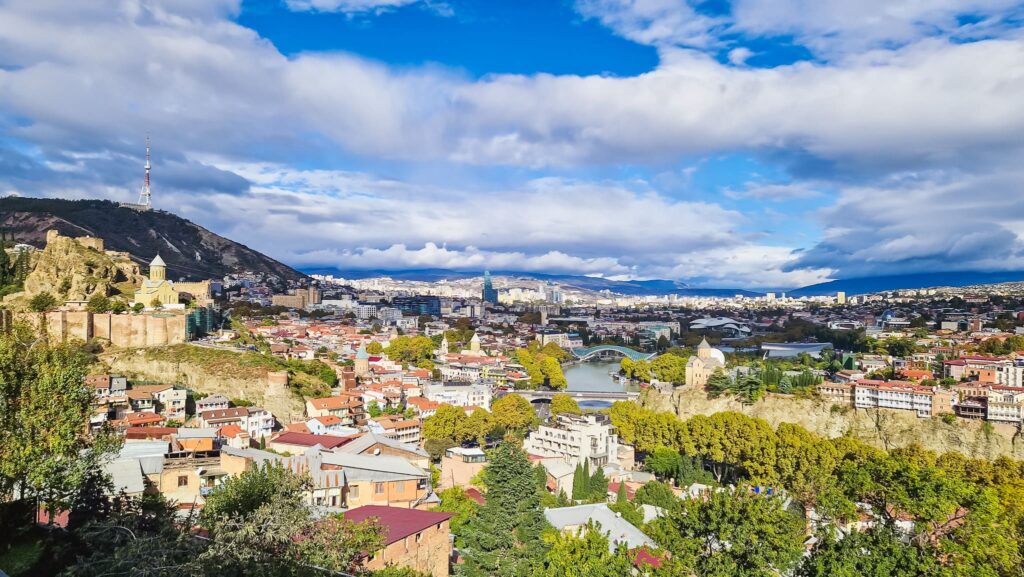
More sweeping views and a quirky amusement park await at the top of Mount Mtatsminda. You have a few options to reach the park, including a funicular railway and a recently renovated cable car that I’ll discuss in the dedicated section on paid things to do in Tbilisi.
If you don’t want to pay for the funicular or cable car ride, you can either hike up or catch a bus (buy a ticket or use your transportation card if you have one). You can catch bus 364 or 390 from the city center, near Liberty Square. If you choose to hike up, it’s quite a long way, so prepare for roughly one hour of uphill hiking.
Dating back to the 1930s, Mtatsminda Park still features some Soviet-era rides, alongside more modern attractions. But I didn’t go there for the rides. I wanted to admire the city sprawling below the highest point in Tbilisi, and I was not disappointed. Plus, the park itself is really cute!

14. Check out beautiful street art
I found lots of incredible street art everywhere in Georgia, and Tbilisi is no exception. While Frabrika is the street art hub, you can see beautiful works all over the city, including the old town.
The area around Sololaki Street is another great spot to go hunting for amazing street art, and so are the underground passages around the city. You can also see a few great works near Dezerter Bazaar.
The entire city of Tbilisi is a huge canvas for street artists. Wherever you go, make sure to look around, and you’ll soon spot a beautiful mural on the side of a random building.

15. Stroll down the polished Rustaveli Avenue
While Tbilisi Old Town and Abanotubani are historical and picturesque, there are many sides to Tbilisi. Rustaveli Avenue is a more polished area, with beautiful 20th-century neoclassical buildings that give Paris vibes. And it’s not just my impression. The wide avenue was built in the late 19th century as part of a project aimed at Europeanizing the city.
Rustaveli Avenue, which gets its name from a renowned Georgian poet, Shota Rustaveli, is lined with beautiful buildings housing museums, hotels, and government offices alongside the residential edifices. If you’re an architecture fan, you must go for a stroll along this avenue and admire the various styles, from Baroque and Neoclassical to Soviet-era architecture.
Here you can find the National Museum of Georgia, the building of the parliament of Georgia, the Tbilisi Art Gallery, and the Georgian National Opera Theater, to name a few. Furthermore, you’ll find many shops and restaurants, which makes this area ideal for an afternoon of shopping and dining.

16. Enjoy the view from the lovely Queen Darejan’s Palace
If you’re looking for a real hidden gem in Tbilisi, this may be the spot for you. When I visited this place on a sunny morning in October, nobody else was around. And that’s shocking, given the wonderful building and amazing views.
Queen Darejan’s Palace, also known as Sachino Palace, is an 18th-century palace complex standing on a cliff a short walk from Rike Park. The palace architecture features Georgian and Persian influences, the latter particularly noticeable in the semicircular balcony.
You can access the complex ground for free and walk on the beautiful balcony to admire the view of Tbilisi. This is one of the best vantage points on this side of the river, allowing you to admire the buildings of the old town. There’s also a lovely garden and a small church that you can also access for free.

17. Join a free walking tour
Okay, while this is technically a free activity, I saved it for last because tipping is highly recommended, so it sits in between the free and paid activities in Tbilisi. But I strongly believe that starting your trip with a walking tour is the best introduction to a new place.
I took this free walking tour with GuruWalk on my first day in Tbilisi, and I’m so glad I did. This was the perfect opportunity to understand the layout of the city and learn about its history and main sights. Plus, it gave me the chance to save the places I wanted to explore more in depth later on, so it was truly the best way to begin my week-long stay in the Georgian capital.
I recommend checking GuruWalk and booking a free walking tour online. You don’t pay anything up front, just tip your guide at the end of the tour (the amount you believe is appropriate).
Paid Attractions and Activities in Tbilisi
Now it’s time to explore some paid attractions and activities in Tbilisi. I believe if you do most of the free things and only a few paid activities, you will already get a good grasp of the city. Also, most museums and attractions have really small entry fees, so you won’t spend much. The biggest expenses will be special activities like sulfur baths or cooking classes. But let’s check them one at a time.
18. Ride the cable cars
I’ve already briefly mentioned the cable cars in previous sections, but I wanted to include a dedicated section since they are paid. However, I believe they offer some of the best views in Tbilisi.
The first and most popular cable car connects Rike Park to Narikala Fortress. The cable car crosses the river, rewarding you with stunning views over the old town. A one-way ride is only 2 lari if you buy it at the ticket office, so it’s super affordable. You can also skip the line and tap your card directly at the turnstile and pay 2.5 lari. If you can only do one cable car ride, I recommend this one.
The second was my favorite, connecting Rustaveli Avenue to Mtatsminda Park. The cable car closed in 1990 following a tragic accident and reopened in October 2024 after thorough renovation works. I happened to be in town just then, so I experienced the ride right after the official reopening. This ride is more expensive, at 14 lari for a one-way ride (12 for the ticket and 2 for the card), but it’s also much longer. If you want the extra thrill, look for the two cabins with a glass floor (numbers 19 and 21). I happened to ride one and loved it!
The last cable car ride in Tbilisi is a bit farther from the city center, connecting Ilia Chavchavadze Avenue to Turtle Lake, a serene area on a hilltop. This one is a Soviet-era cable car, and a ride costs only 1 lari. Unfortunately, I didn’t get to ride this one, so if you do, let me know your thoughts!

19. Indulge in Georgian food
Your trip to Tbilisi would be incomplete without sampling the flavorful Georgian cuisine. For some, this is among the best cuisines in the world. Personally, while I did like many dishes I tried, I had a hard time with the massive amounts of cheese and the coriander (cilantro) sprinkled everywhere. Yes, I’m one of those people who absolutely hate coriander!
But that’s just personal taste, and as I said, I loved a lot of dishes. If you like cheese and coriander, Georgia is your place! But they do have a variety of traditional foods with other ingredients, so if you’re weird like me, you can still find something for your taste.
Of course, khachapuri (cheese bread), khinkali (Georgian dumplings), and pkhali (veggie spreads) are some must-try. The boat-shaped khachapuri is particularly iconic. I mean, can you even say you travelled to Georgia if you didn’t eat one? Even I had to try it!
Pro tip: There’s a right way to eat khinkali, and it’s with your hands. Absolutely do not use a fork and never, ever cut the dumpling with a knife, or you’ll spill the broth and waste the best part. You use your hand, grab the khinkali by the tip, take a tiny bite in the side, suck all the broth out, and proceed to eat the dumpling and filling by biting into it. The broth part applies particularly to the meat-filled khinkali. Here’s a reel of me attempting to blend in while eating khinkali.

Meals in Tbilisi can be quite inexpensive. Aside from the traditional Georgian cuisine, you can find a huge variety of international cuisines. Below are some of my favorite spots in the city.
Where to eat and drink in Tbilisi

20. Visit the newly restored Silk Museum
Now this is a true hidden gem in Tbilisi. This small museum close to Dezerter Bazaar was a delightful surprise during my trip. I’d learned about its reopening from Emily at Wander-Lush, who is quite the expert on Georgia travel if you want more in-depth insights. Her guides were super helpful during my trip.
The State Silk Museum, first opened in 1887, is among the oldest silk museums in the world. If you didn’t know, Georgia is on the ancient Silk Road (aka the Silk Routes), which is a series of routes connecting East Asia to Southern Europe and East Africa, passing through Central and West Asia. As the name suggests, the routes were mainly used for the trade of silk textiles, which were mainly produced in China.
The Silk Museum in Tbilisi was recently renovated and reopened on October 9th, 2024, exactly 135 years after the museum’s foundation stone was laid. The entrance fee is only 12 lari, so there’s no reason not to visit this interesting little museum. Plus, there are very few international visitors, so no crowds here. Just note that the museum is closed on Sunday and Monday.

21. Go for a walk in the National Botanical Garden
Though it pales in comparison to the Batumi Botanical Garden, the Tbilisi one is a tranquil oasis right in the city center, offering a breath of fresh air and a nice break from the buzzing old town. Dating back to the early 17th century, this used to be a royal garden and only became a botanical garden in 1845.
More than exotic plants and curated layouts, you can expect shady trails among tall trees, small waterfalls, and plenty of space to enjoy a picnic on a warm summer day. I visited on a chilly autumn afternoon, so no picnic for me, but I loved the peaceful atmosphere. Plus, the entrance was only 4 lari.
Tip: If you want an adrenaline-filled entry to the botanical garden, consider ziplining from Narikala fortress, which will drop you near the garden entrance! The ride costs 60 lari for one way.
P.S. I have a post about Batumi in the works, but in the meantime, you can check my article on day trips from Kutaisi, where I also included a guided Batumi day trip.

22. Check out contemporary art at MoMA Tbilisi
If you like modern and contemporary art, MoMA Tbilisi is the place to go. While mainly focusing on the works of Georgian artist Zurab Tsereteli, MoMA Tbilisi also offers a beautiful display of works by other Georgian and international artists, including frequent temporary exhibitions.
I was saving my visit to MoMA Tbilisi for the last day of my trip, and for some reason, I found the museum closed for “technical reasons.” I suspect it had something to do with the elections about to take place and the general unrest they were causing all over the city.
If, for some reason, you don’t get to check out the art collection at MoMA Tbilisi, make sure to at least walk by and check out Tsereteli’s sculpture Apple of Love in the museum’s courtyard. For those luckier with opening times, the entry fee is 20 lari.

23. Learn about local history at the Georgian National Museum
If history is more your cup of tea, the Georgian National Museum is the best place to learn about the country’s long history. I was unfortunate with this museum too, so I can’t give you first-hand information, but it’s one of the most renowned museums in Tbilisi and a must for history lovers.
From Georgia’s prehistoric times to the Soviet occupation, the museum contains artifacts from every stage of the city’s history. Furthermore, you can usually find temporary exhibitions.
The museum is open daily, except on Mondays and official holidays. There are quite a few, so check them on the museum’s website. Also, this museum is a bit more expensive at 30 lari for foreign visitors.
24. Experience a sulfur bath
I already told you about Abanotubani, the bath district in Tbilisi Old Town. Now it’s time to focus on the main activity here: sulfur baths. There used to be over 60 baths in this area in ancient times, while now, fewer than a dozen remain. But they are more than enough to enjoy this experience.
First, it’s worth distinguishing between private and public baths, with many structures offering a mix of both. As you can imagine, the public baths are a lot cheaper, starting at only around 10 lari for one hour, while private ones are upwards of 80 lari/hour and can get as expensive as 600 lari for a luxurious experience.
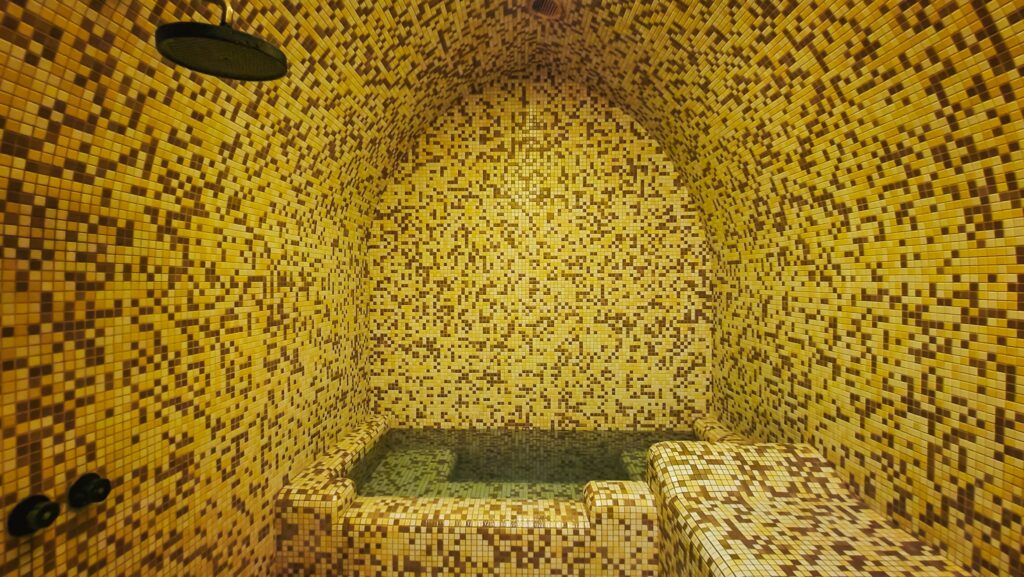
I chose the iconic Chreli Abano, the most recognizable bathhouse with a stunning mosaic façade. I opted for one of the cheaper private baths and added a cup of tea and the kisa scrub. If you get the scrub, you also need to buy a single-use or a reusable scrub glove. In total, I paid around 150 lari for everything, which came to roughly €47 or US$55. Read more about it in this post about the sulfur baths in Tbilisi.
The kisa scrub is a must-try. This vigorous scrub will undoubtedly remove all the dead skin cells from every inch of your body, and then some, and you’ll leave as smooth as a newborn. It’s a borderline traumatic experience, but absolutely worth it! I’ll have a detailed post about it soon! Just remember to bring cash for the scrub.
Other popular bathhouses are Orbeliani Baths, Royal Bath-House, Gulo’s Thermal Spa, and King Erekle’s Sulfur Bath.
25. Sample Georgian wines
Did you know Georgia is considered the cradle of wine? The country has a winemaking tradition that goes back more than 8000 years, older than any other European country. Furthermore, winemakers still use ancient methods consisting of fermenting wine in qvevri, big clay pots kept buried underground.
A trip to Georgia would just make no sense without learning about its winemaking history and trying a few local wines. I’m not a huge fan of wine, but even I couldn’t help but seek out wine tours and try Georgian wines for a better understanding of the country’s rich history.
Obviously, the best way to learn about winemaking is to take a tour of one of the wine regions. I joined this day trip to Kakheti, and I loved it not just for the wine but also for the wonderful landscapes and the other activities included, like making churchkhela. I also have a dedicated post about the Kakheti wine region tour.
If you’re only staying in Tbilisi, you can still experience Georgia’s wines. Head to one of the many places that offer wine tastings, like Wine Factory N1. Or book an activity online, like this Tbilisi wine tasting or this one in a historic wine cellar.
26. Have dinner and drinks at Fabrika
Fabrika is Tbilisi’s alternative, underground hotspot for drinking, dining, and attending various events. A Soviet-era sewing factory, Fabrika, was transformed into an incredible creative hub featuring a hostel, a co-working space, several restaurants and bars, shops, and event spaces.
The place comes alive in the evening, when both locals and tourists gather here to enjoy dinner and have a drink. Have some ramen at Shio Ramen or a burger at PIPES Burger Joint, then grab a beer at Camora or taste some wine at Saamuri Wine Bar.
Make sure to check out what events are on while you’re visiting. From vintage markets to wine salons and exhibitions, there are always cool things going on. Honestly, you’d be missing out if you didn’t check out Fabrika on your trip to Tbilisi. While I placed this in the “paid activities”, you can also just admire the space and the wonderful street art!

27. Attend a show at Tbilisi Opera and Ballet Theatre
Let’s move from the underground, post-industrial vibes of Fabrika to the lavish Tbilisi Opera and Ballet Theatre. The Moorish building stands out from the surrounding architectural styles on Rustaveli Avenue, with its richly decorated façade.
Tbilisi Opera is among Eastern Europe’s oldest opera houses, dating to 1851. However, its appearance dates to 1896, when it was finally reopened after long renovation works following its destruction due to a fire in 1874.
The only way to admire the theater’s elegant interior is to attend a performance. You can attend opera, ballet, or symphonic concerts. Prices start from only 20 lari, so it can be super affordable. Check out the shows and ticket options on Tkt.ge.

28. Admire beautiful artworks at the Georgian Museum of Fine Arts
The Georgian Museum of Fine Arts is another museum worth checking out on your visit to Tbilisi. Housing thousands of artworks by over one hundred Georgian artists, the museum is a must-see if you’re interested in local art.
The collection includes modern and contemporary artworks. Alongside the permanent exhibition, you can also check out temporary displays. The museum also has a café and a coworking space you can use.
The Fine Arts Museum is a short walk from Liberty Square, on the beautiful Rustaveli Avenue. The entry fee for foreigners is 30 lari, and the museum is open from Tuesday to Sunday. The museum café remains open until later in the evening.
29. Join a cooking class
If you’re a fan of Georgian cuisine and want to attempt replicating the dishes at home, why not take a cooking class? This is a great way to learn the secrets of local cuisine while also diving deeper into the country’s culture, which is always so deeply connected to its food.
You can find plenty of cooking classes in Tbilisi, where you can learn to make traditional dishes like khinkali or khachapuri. You’ll not only learn the recipes, but also get to eat everything, usually with a glass or two of Georgian wine.
Check out this Georgian Cooking Class with Kinkhali and Khachapuri. You’ll get to learn the secrets of Georgian cuisine from the chef of KITCH Bistro.
30. Sample Georgian tea at Bitadze Tea Museum
Yes, Georgia is known for its wine production, but did you know it also produces tea? It’s easy to overlook this fact when the winemaking culture is so pervasive, but at one point, Georgia was the world’s fourth-largest tea grower.
So, tasting some locally grown tea is another amazing thing to do in Tbilisi. The Bitadze Tea Museum is the perfect place for this, located in a lively street in Old Town Tbilisi. I was once again unlucky during my stay and headed there on my last evening, only to find a private event was taking place, so we could barely take a look around.
Despite its name, Bitadze Tea Museum is a small tea shop. You can check out vintage tea-related memorabilia, attend a tea ceremony and tasting (40 lari per person), and buy some Georgian tea to take home.

Getting to and Staying in Tbilisi
I think I have given you plenty of things to do in Tbilisi, whether you’re traveling on a budget or can splurge on cool activities. Now, let me end this article with some advice on how to reach Georgia’s capital and where to stay.
How to get to Tbilisi
Firstly, Georgia has three international airports you can fly into: Tbilisi, Kutaisi, and Batumi. A lot of low-cost airlines fly to Kutaisi, which is what I did. But you can also find lots of flights straight to Tbilisi.
If you land at Tbilisi Airport, you can either catch bus 337 to the city center (it ends at the train station and passes through Old Town Tbilisi) or get a taxi. Download Bolt beforehand to order a taxi through the app, which is safer than hailing a taxi outside the airport. If you catch the bus, you can also pay directly by card.
I flew into Kutaisi, then traveled to Batumi, and took a train from there straight to Tbilisi. The train ride took roughly 5 hours for just under 40 lari. There are only a few daily departures, but they are more than enough. Plus, trains are quite modern and comfortable. You can find more details and book your train tickets on the Georgian Railway website.

P.S. From Tbilisi, I traveled by train to Yerevan, in Armenia. Read all about the train ride here.
Where to stay in Tbilisi
If you book your accommodation in Tbilisi Old Town, chances are you’ll rarely ever catch any public transportation. I stayed in Sololaki, just 5 minutes from Liberty Square, and I only took the metro and bus a few times.
Sololaki is a lovely area to base yourself in, with lots of restaurants, bars, and cafés. I loved it there and highly recommend it! But anywhere in Old Town Tbilisi, within a 15-minute walk from Liberty Square, is a great option. Below are a few recommendations:
BUDGET
Cheap beds in hostels
MID-RANGE
Comfy private rooms
Or you can browse for more options on the map below:
That’s all for this one. I have more articles on Georgia coming soon. If you want to know about them as soon as they’re live, sign up for my newsletter.

Travel Resources
I’ll leave you with a list of the travel resources I mentioned throughout this article, plus a few more that I use regularly.
| Website/App | Category | Description | Book Here |
|---|---|---|---|
| Booking.com | Accommodation | My favorite website for great accommodations for different budgets. | Find a Place |
| Kiwi.com | Flights | My new favorite platform for finding affordable flights. | Find Flights |
| Omio | Transportation | You can book everything from buses and trains to ferry rides. | Transportation |
| SafetyWing | Insurance | One of the best travel medical insurances for frequent travelers. | Get Insured |
| Manawa | Activities | A great platform to book activities and adventures with local hosts. | Find Activities |
| GetYourGuide | Activities | My go-to platform for tours and experiences with lots of options. | Experiences |
| Viator | Activities | A great alternative for activities all over the world. | Experiences |
| GuruWalk | Free tours | A great platform for free walking tours (tipping is recommended). | Book a tour |
| DiscoverCars | Car rental | My go-to platform for car rental anywhere in the world. | Rent a Car |
| Airalo | eSIM | My favorite app for buying digital SIM cards when traveling abroad. | Get an eSIM |
| Saily | eSIM | A great alternative to Airalo, with cheaper plans in some destinations. | Get an eSIM |
| Xe | Currency | A currency converter showing real-time rates. Website or app. | Get Xe App |
| Maps.me | Navigation | My favorite navigation app for hiking trails and remote areas. | Get Maps |
Pin this post for later!